The Capital Spectator (see here) has a post on what sounds like a very useful new book about retirement planning, The 7 Most Important Equations for Your Retirement by Moshe Milevsky. The Spectator says,
"It's also time to start doing the math. Milevsky, a professor at York
University who's written extensively on retirement planning, takes the
reader on a brief but revealing tour through seven equations that he
argues (persuasively) that are essential for answering such questions
as: How long will my nest egg hold out? How long is my retirement likely
to last? How should I structure my spending plans in retirement? What
is the probability that my retirement plan is sustainable."
I've put the book on my "to read" list.
Tuesday, May 29, 2012

March Case-Shiller Housing Index
Calculated Risk (see here) provides us with an updated graph of the March Case-Shiller Housing Index.

Phil Izzo at the Wall Street Journal (see here) talks about the results. He says,
"Thirteen of the 20 cities posted annual declines in March, but Phoenix, Minneapolis, Denver, Miami, Detroit, Dallas and Charlotte notched gains. On a seasonally adjusted basis, which aims to take into account the slower selling season in the winter, things looked a little better. The overall 20-city index was up 0.1% from the previous month, and just four cities posted monthly declines."

Phil Izzo at the Wall Street Journal (see here) talks about the results. He says,
"Thirteen of the 20 cities posted annual declines in March, but Phoenix, Minneapolis, Denver, Miami, Detroit, Dallas and Charlotte notched gains. On a seasonally adjusted basis, which aims to take into account the slower selling season in the winter, things looked a little better. The overall 20-city index was up 0.1% from the previous month, and just four cities posted monthly declines."
2012 Milliman Medical Index
In a report about the cost of health care (the 2012 Milliman Medical Index, see here), there is the following (very interesting graph).

Uwe Reinhart (see here) has a post about the report in which he says:
"The virtue of this index lies in its inclusion of out-of-pocket spending in total health spending. Just tracking premiums for employment-based health can be misleading, if employers shift more and more of the cost of health care out of their benefit package into deductibles or coinsurance paid by employees, exclude certain benefits altogether or otherwise limit coverage."
"For 2012, the nationwide average of the total health spending for a typical family of four was estimated by Milliman to be $20,728. On a regional basis, that average varies from a low of $18,365 in Phoenix to $24,965 in Miami."
Reinhart has the following chart in his post:

He makes the following (important) observation:
"Americans are fond of the idea that individuals and families should be self-reliant. But a question confronting the American public and their political representatives is how they imagine households with money income of, say, $30,000 to $50,000 will tolerate the ever-larger bites the health care Pacman seeks to take out of their budgets."

Uwe Reinhart (see here) has a post about the report in which he says:
"The virtue of this index lies in its inclusion of out-of-pocket spending in total health spending. Just tracking premiums for employment-based health can be misleading, if employers shift more and more of the cost of health care out of their benefit package into deductibles or coinsurance paid by employees, exclude certain benefits altogether or otherwise limit coverage."
"For 2012, the nationwide average of the total health spending for a typical family of four was estimated by Milliman to be $20,728. On a regional basis, that average varies from a low of $18,365 in Phoenix to $24,965 in Miami."
Reinhart has the following chart in his post:

He makes the following (important) observation:
"Americans are fond of the idea that individuals and families should be self-reliant. But a question confronting the American public and their political representatives is how they imagine households with money income of, say, $30,000 to $50,000 will tolerate the ever-larger bites the health care Pacman seeks to take out of their budgets."
Thursday, May 24, 2012
New survey on the importance of financial security
Catherine Rampell over at the New York Times (see here) reports today on a new survey that addresses how different generations compare on their ranking of "life goals." Interesting reading.

She does point out the following: "This is the first time the Heldrich Center asked these specific questions, so it’s hard to know to what extent these generational differences are due to aging, current (and eventually passing) economic conditions or something culturally specific to each age cohort."
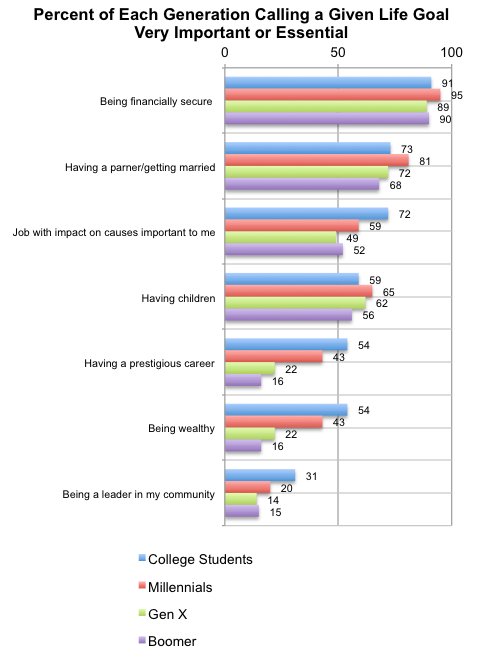
She does point out the following: "This is the first time the Heldrich Center asked these specific questions, so it’s hard to know to what extent these generational differences are due to aging, current (and eventually passing) economic conditions or something culturally specific to each age cohort."
Wednesday, May 23, 2012
When the student becomes a customer, ....
A story in the Washington Post (see here) highlights some recent data on the number of hours that students study each week while in college.

The story reports the following comparison: "Over the past half-century, the amount of time college students actually study — read, write and otherwise prepare for class — has dwindled from 24 hours a week to about 15, survey data show." The report is likely to elicit a big yawn from most people and that's too bad. I've been a college professor now for about 15 years and my experience is very consistent with the results of the study. And, yes, there are lots of reasons (several mentioned in the study). The one at the top of my list is the insistence that students be viewed as "customers." When students become customers, these customers tend to see themselves less and less as students (that is, as people who have voluntarily submitted to a chosen course of study that demands engagement and significant time).

The story reports the following comparison: "Over the past half-century, the amount of time college students actually study — read, write and otherwise prepare for class — has dwindled from 24 hours a week to about 15, survey data show." The report is likely to elicit a big yawn from most people and that's too bad. I've been a college professor now for about 15 years and my experience is very consistent with the results of the study. And, yes, there are lots of reasons (several mentioned in the study). The one at the top of my list is the insistence that students be viewed as "customers." When students become customers, these customers tend to see themselves less and less as students (that is, as people who have voluntarily submitted to a chosen course of study that demands engagement and significant time).
Tuesday, May 22, 2012
A good gig, if you can get it...
"The report from Good Jobs First, a nonprofit taxpayer watchdog
organization funded by Ford, Surdna and other major foundations,
identifies 16 states that let companies divert some or all of the state
income taxes deducted from workers’ paychecks. None of the states
requires notifying the workers, whose withholdings are treated as taxes
they paid." (see here) Well, information that starts out like this isn't likely to be ... encouraging. And it isn't.

And even closer to home, see the graph below.


And even closer to home, see the graph below.

Can "the market" fix everything?
Before you answer that question, I highly recommend a visit to the Boston Review Forum on "How Markets Crowd Out Morals" (see here). It will be worth your time.
Subscribe to:
Posts (Atom)